
Miranda Was Right
It was never Beauty vs Substance. The Devil Wears Prada 2 knows the real villains are the Optimizers.

Miranda Was Right
It was never Beauty vs Substance. The Devil Wears Prada 2 knows the real villains are the Optimizers.
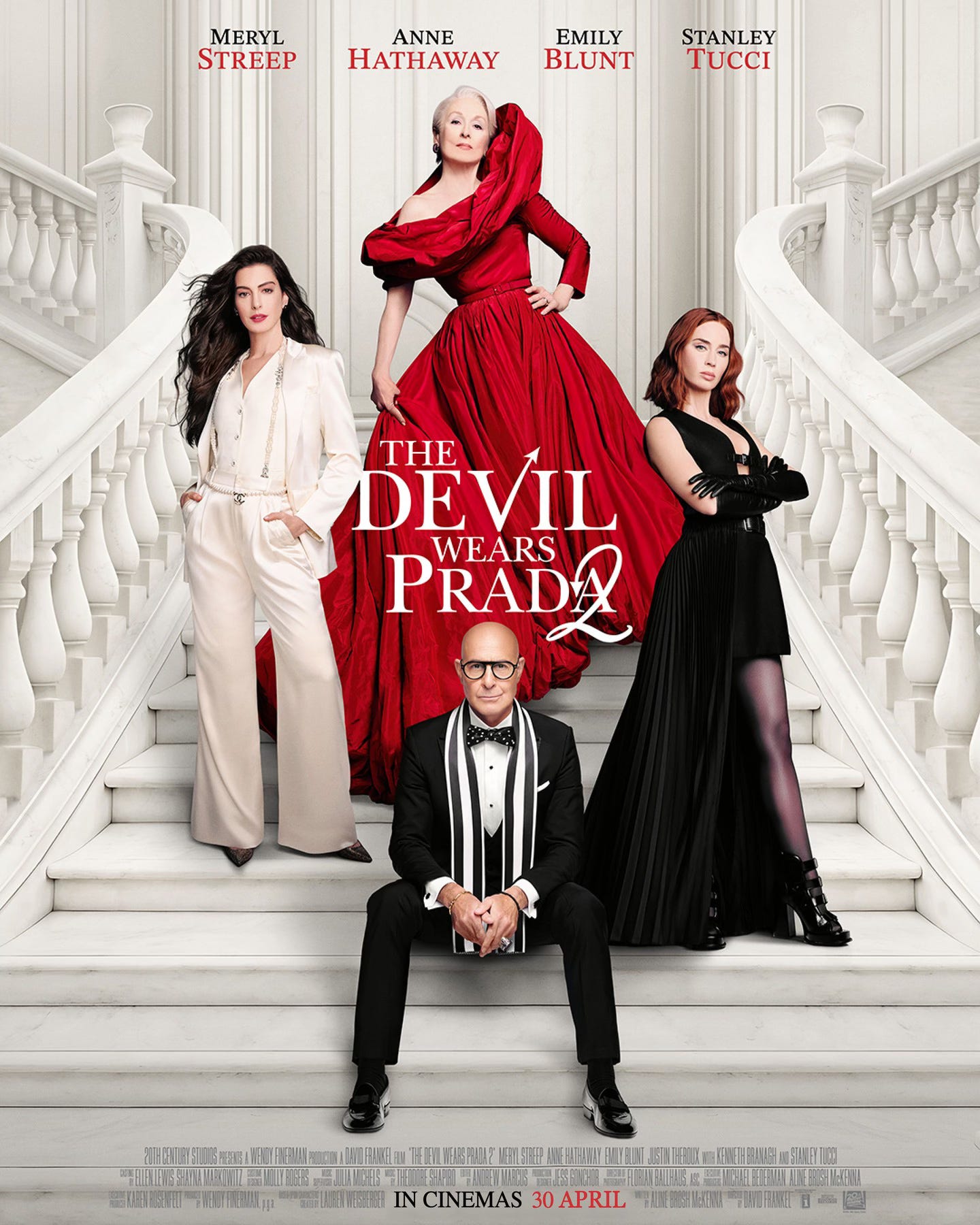
The 2006 film, whatever its makers intended, sold the life it claimed to critique, and it glittered for all the young women watching. Andy in Paris in Chanel, the townhouse, the closet, the private car rides, the lunches, the Starbucks runs, the taste makers and the celebrity and the prestige. The moral architecture of the film was Andy walks away from glamour and chooses substance. The cultural delivery was here is what glamour looks like, study it carefully. The walk in Paris was a fig leaf hiding the fact that the seduction had already happened, and the two hours of film were the real argument, and we took the real argument home dreaming of Chanel in Paris.
The film contained three refutations of its own moral arc and could not afford to let any of them land. Miranda’s car speech telling Andy she was already inside the system. Nigel’s defense of Runway as a shining beacon of hope, the magazine that kept him alive as a boy in Rhode Island reading under the covers with a flashlight. And the cerulean monologue, tracing the chain of human attention that produced the lumpy blue sweater Andy wore to mock the industry. Three characters, three speeches, all making the same argument. The film staged each one and let Andy’s walk override them. Twenty years later the studio has finally let all three be right.
The conditions that made the walk legible
The walk read as victory because the world Andy was walking toward still existed. Conde Nast had not yet folded Pitchfork into GQ or shuttered Self magazine, Bezos did not own the Washington Post, and the newsroom Andy would interview at still had independent editorial control. Content was not free. Newspapers and magazines were paid for, the economic model still supported serious writing, and readers were not yet jaded by a decade of watching trust in media collapse.
Millennial women coming into adulthood at the time took the message and chose accordingly, but the message they took was not Andy’s walk. The message was the year before the walk. We wanted to work at Runway. We watched Andy complain about the job and we wanted the job anyway. We wanted the closet montage and the makeover scene and the Paris trip in the wrong woman’s place. We wanted Nigel choosing our boots. We wanted Miranda’s impossible assignment, the one that would ruin our relationship and prove to everyone we were ambitious. The walk was the moral exit the film allowed us to point to when asked what the film was about, but the lives we built were lives that ran toward Runway, not away from it.
Joanna Coles took over as editor-in-chief of Marie Claire the same month the original opened, and writes about the era when working at a magazine in New York was social gold dust. Emilia Petrarca got into W magazine when it was still under Conde Nast, attended fashion weeks, embarrassed herself in front of Anna Wintour, and is now a freelance Substack writer making the work without the building. Rachel Kellogg was eighteen and watching the film for clues about what a corporate life could look like, since her parents were academics and the world after university was a question she had no other way to answer. Inside the building, on the way out, watching from the seats. Three positions inside the same audience.
This was the time of The Hills and Sex and the City, when proximity to a glamorous magazine or a glamorous column was an entire life plan, and the world supported the imagination because the institutions supporting it were still functional.
All three of those conditions are gone. Media is conglomerated, content is free, readers are jaded. The walk Andy took in 2006 is not available in 2026 because the buildings she was walking toward have been bought and merged and shuttered and folded into one another, the way WeWork bought up rooms.
The 2026 admission
The Devil Wears Prada 2 opens with Andy at a journalism award dinner at a New York newspaper. Her newsroom is laid off by text mid-ceremony, the owners are shutting the paper down, and the CEO commands an eleven million dollar salary. The text arrives while Andy is at the table. She delivers a speech about journalism mattering more than money, and the speech goes viral. The film names, in its first ten minutes, the collapse of the institutions that made her walk away in Paris legible. She is, in the cold opening of her own sequel, the proof that her own victory has been undone by twenty years of slow corporate consolidation.
Irv Ravitz, who owns Elias-Clarke and therefore Runway, sees the viral speech and hires Andy as features editor, and we learn later that this too was planted by Nigel, still turning the cogs. Runway is in its own crisis. Miranda approved a glowing profile of a fast-fashion company that turned out to use sweatshop labor, the magazine needs respectability, and Andy’s job is to provide it. Beauty and substance team up.
The film has two antagonists. Jay Ravitz, played by B.J. Novak, is Irv’s son who inherits Elias-Clarke and immediately hires Boston Consultants to figure out which departments to cut. An enemy in polyester and inattention.
Every mid-sized city has a Jay. He sits on the board. His wife runs the fundraiser galas.
Benji Barnes, played by Justin Theroux, is the Jeff Bezos-style tech billionaire dating Emily, who tells Miranda the magazine will be run by AI in the near future, no photos, no models, no clothes, the AI doing all of it. The optimizer’s logical end, the man who has looked at a magazine and concluded that the human inputs are inefficiencies. The whole supply chain of human attention the cerulean monologue described is what he wants to replace with a generative model. The line lands a little too close to home.
Miranda’s verdict on Emily lands like a sentence. You’re not a visionary, you’re a vendor. The visionary looks and selects and arranges and makes choices that other people then live inside. The vendor delivers an undifferentiated product at the lowest possible cost. Emily thinks she is a visionary because she has Benji’s money and her own ambition. She is the latest in a long line of people who have mistaken access to capital for understanding of culture. She sells. She does not see. Hello, Lauren Sanchez Bezos.
Andy comes back to Runway. First-film watchers read it as defeat, she is a sellout, but she has bills to pay and nostalgia sells us. Further into the second film we read it as alliance. Andy returns not because she failed at substance but because substance has nowhere else to live, and the two women positioned as opposites in 2006 are co-defenders in 2026 because Jay and Benji have made the alliance obvious. How ironic that the fashion industry has bought into this film so completely, the Vogue cover with Miranda and Anna Wintour, the lines and lines of merch, when the film itself is a portrait of how the optimizers are everywhere else. Miranda tells Andy late in the film that she always knew she would achieve greatness, despite earlier pretending not to remember her. Twenty years of feigned forgetting drop in one line.
The film ends with a billionaire savior, Sasha Barnes, the tech-money divorce turned patron, played by Lucy Liu. The same fantasy that failed Bezos at the Post and Soon-Shiong at the LA Times. A last desperate move of the dying institution, not the shape of what comes next.
What was never the choice
Jay calls Miranda into a quick meeting and the meeting is scheduled into her lunch break in the staff cafeteria. The first beat is funny. Miranda does not know where the cafeteria is, because she eats from proper plates at her desk or she goes out, and the audience has waited twenty years to see her walk into a room she does not know how to navigate. The second beat is the consultants in their quarter-zips, presenting their framework with the bro-y patience of men who have never made anything and have decided that Runway needs to be optimized, and we recognize them because we have all met them in our own offices and they are caricatures of caricatures by now. The third beat is Jay, who is not really listening, who has not read the data the consultants have summarized, who hired them precisely so he would not have to read it. The audience came into the scene smug, sat through the humbling of a woman they have spent two films wanting to see humbled, and left with the unwanted recognition that the people doing the humbling are worse than she ever was. Miranda hurt the people in front of her. Jay does not even look up. That is enshittification staged as a scene rather than as a concept, and the film does not need any dialogue to make the point because the staging is the argument. The optimizers do not even know they are villains because they do not look up long enough to see what they are doing.
Beauty without substance is decoration and substance without beauty is dry, and the two only function together as human attention exercised on the world. Miranda’s whole career was the proposition that the discipline of looking produces substance. The cerulean monologue made the argument from outside. Nigel’s speech made it from inside. Andy spent the first film treating both as moral failures, and the second film admits they were correct all along.
The real antagonist is the machine the optimizers ride. Optimization is the elimination of friction, friction is the precondition for attention, so optimization is the structural enemy of any practice that requires someone to stop and look. Jay cannot pay attention because his life has been engineered out of needing to, with consultants for thinking and slide decks for everything and a calendar that disposes of a thirty-year career on someone’s lunch hour. Benji is worse, because Benji proposes to replace human attention with AI. The polyester is congruent with the cognition. The fabric that came from no chain of human attention is worn by the man who has been engineered so the difference does not register. The optimizers cannot produce beauty or substance because they cannot produce friction, and without friction there is nothing for either of them to be made of.
The redistribution
There is a scene where Miranda and Andy stand in front of the Last Supper. Five hundred years of human attention preserved on a refectory wall in Milan. The film puts them there together, in a single composition that includes the painting, and the scene does in image what the rest of the film does in dialogue. This is what we mean by beauty. This is what the cerulean monologue was reaching toward. This is what Benji wants to replace with AI. Five hundred years and people still travel to a wall, wait in line, get their fifteen minutes, leave changed. Whatever optimization is, it has not yet figured out how to replicate this, and the film knows it.
This is what the consolidators cannot reach. The need does not die when the institutions die. It just goes looking for new walls.
The cleanest evidence is Barnes and Noble. The chain is opening sixty new stores in 2026 after dozens in 2025, ending more than fifteen years of declining numbers, and the strategy in the company’s own language is to hand control of each store to its local booksellers. Decentralized expertise inside corporate infrastructure. The local manager picks the selection, runs the events, looks at the actual community. A publicly traded company turning itself around by refusing central optimization, the literal opposite of what Jay would do, and it works. It is opening stores while every other physical retail category is contracting.
The customer is not paying for the books, which are cheaper online. The customer is paying for the curation, which is to say the attention. The bookstore is selling friction wrapped around books. The new path does not exist yet, but the Barnes and Noble strategy shows one shape it can take at scale.
The same phenomenon is happening at smaller scale in places the optimizers cannot reach. Independent bookstores, vinyl, print zines, letterpress, small presses doing the literary work the consolidated houses cannot afford to support. The Substack economy, the experience economy, local makers, people paying for the workshop and the in-person reading and the limited run. The common thread is friction, and the thing being paid for is the requirement to be present.
The 2026 film is part of the same phenomenon and may not know it. Released only in theatres. To see the film a person had to go to a building, sit in the dark, watch it once, leave with what they carried. The film about the death of human attention demanded human attention to be seen, and the friction produced the writing now appearing across the culture.
The redistribution is real and uneven. Retail is correcting, vinyl is correcting, bookstores are correcting. Literary fiction is harder. The big publishers have consolidated to five, and one of them, Penguin Random House, holds more than three hundred imprints, which means most of the names a reader trusts on a spine are billing addresses inside one company. In 2022 a federal antitrust suit blocked Penguin Random House from buying Simon and Schuster, which would have made the Big Five into the Big Four. The advances are shrinking. The midlist is disappearing. The institutions are buying time. They are not winning.
Emily at the bottom
Miranda gets a few more years. She says so in the car with Andy, in the same backseat where she once told Andy that everybody wants this and everybody wants to be them. The 2006 car speech was Miranda telling Andy she was already inside the system. The 2026 car admission is Miranda telling her she is buying time inside it. Twenty years, the same vehicle, the same two women, and the truth has been compressed into a phrase the first film could not afford to say.
Andy sort of wins and we sort of hate her. She wins today.
The redistribution of our attention is the opposition to the tech bro machine. The writer who calls herself a writer today is making a political claim, refusing the available rebranding. She is not a Content Creator, she is not an Influencer, she is a Writer. The small press that publishes her is making the same claim. The local bookstore that stocks her is making the same claim. The reader who pays for the book is making the same claim. None of them are saving the industry. They are building outside the industry.
Emily has spent twenty years trying to be Miranda, giving the hardest go at what us little girl millennials hoped to be. She left Runway, built a career at Dior, dated well, positioned herself for the Runway acquisition with Benji, tried to oust Miranda and take the chair. She used every tool the optimizers were leaving lying around because the actual tools, the staircase from copy desk to editor-in-chief that Miranda climbed when the masthead had a middle, did not exist for her to climb. She was the machine’s best student, the woman who learned its terms most thoroughly because the path she actually wanted was demolished before she could finish walking it.
And the ladder delivers her nowhere. Benji leaves her, the takeover collapses, the film closes with freshly dyed blonde hair. The machine’s best student arrives at the bottom of the hill with whatever she can carry. She and Andy reconcile, the two assistants who started in the same chairs in 2003 back together, but one of them built something durable through refusal and the other is starting over because the path she chose led nowhere.
The future of this world is Emily and Andy rebuilding. Freshly dyed blonde hair, a slightly better office, a maybe-boyfriend, a byline at the only magazine left that takes the work seriously. Neither of them is finished. Both are improvising from inside the dying institution and outside it.
We cannot follow the old path and there is not one laid out yet. The redistribution of our attention will carry us into the next cycle. Not a resurgence. Not a rebirth. It is going to look different and maybe it has a bad blonde dye job.